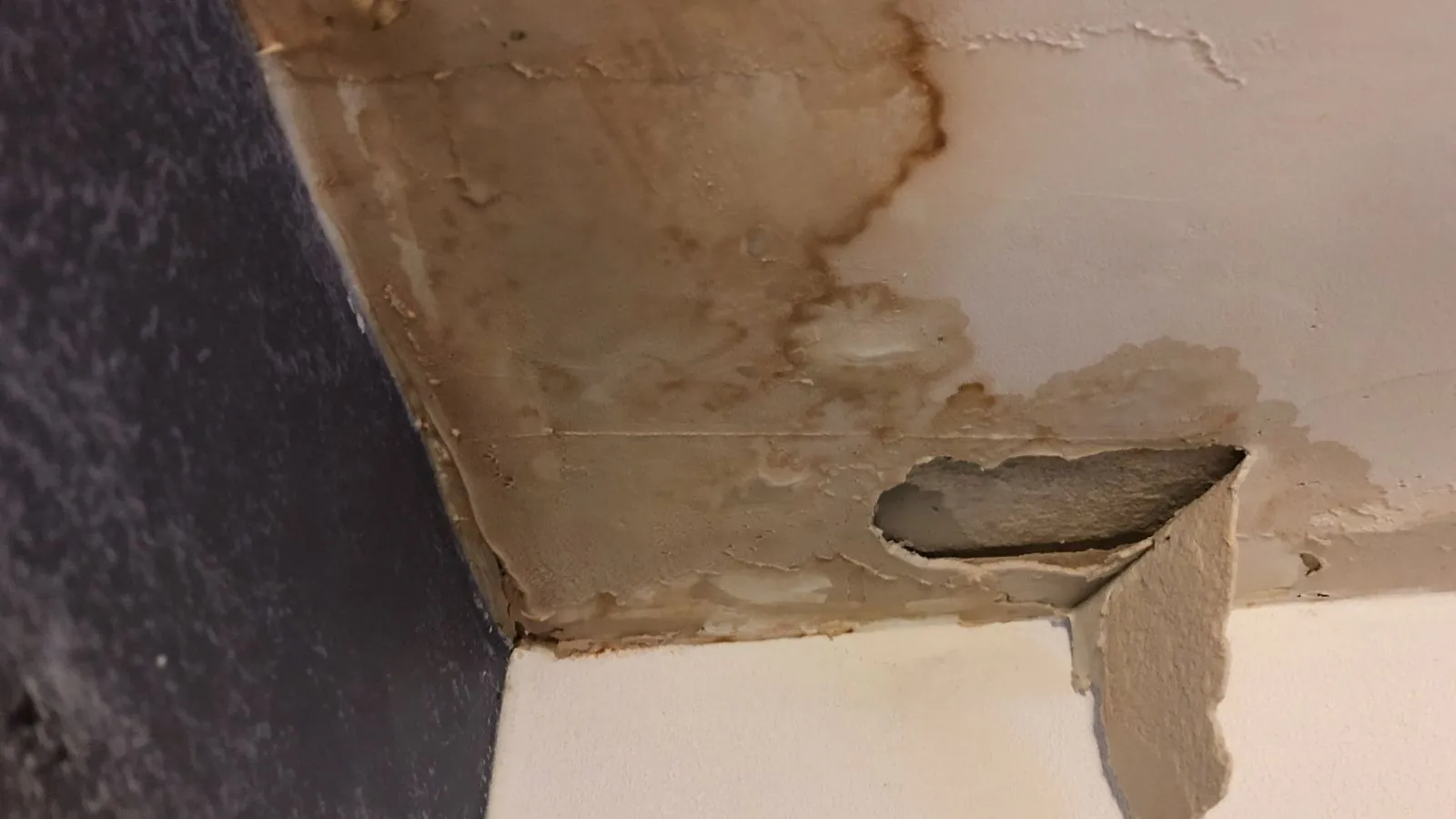
Ceiling water damage repair begins above the stain
Ceiling water damage repair is the work of drying, removing and replacing a finished ceiling that has been soaked from above, and of finding the source before the new drywall goes up. In Wheeling, WV, the source might be a roof leak, an upstairs bathroom, a supply line in the attic or an air conditioning drain pan. The stain is only the point where water finally came through.
This page also covers roof leaks, because the ceiling is where a roof leak becomes visible. Roofing repair itself is a roofer's job, and we focus on the water damage inside the home.
When a ceiling leak is an emergency
A ceiling is an emergency when it is dripping, bulging, sagging or has changed color quickly. Water pooled above a ceiling adds weight, and a bulge can fail without warning. The dispatch line is open 24/7 and same-day response is offered when available.
- Move people and furniture away from the sagging area..
- Put a bucket under any drip, and poke a small hole in the lowest point of a bulge only if it is safe, so water drains in a controlled way instead of dropping a section..
- Turn off power to any light fixture or fan in the wet area, using the panel if it is dry and reachable..
- If the water comes from a supply line, shut off the main valve..
- Photograph the ceiling before anything is touched, and call the line..
Roof leak water damage, and why it hides
Roof water seldom shows up directly below the leak. It runs along rafters, soaks insulation and appears several feet away. Shingles lifted by wind, flashing around a chimney, a valley and an old vent boot are common entry points. The practical advice is to get the roof opening closed by a roofer, then deal with the interior.
In the older neighborhoods of Wheeling, such as Woodsdale, Pleasant Valley and Elm Grove, attics and dormers can have a long history of repairs. Ask your roofer to check around penetrations and old patches, because a stain that returns after painting means the water is still coming from somewhere.
What the repair involves
Crews measure moisture in the drywall, the framing and the attic insulation. Wet insulation is removed, damaged drywall is cut out beyond the stain edges, and the cavity is dried with air movers and a dehumidifier. Once readings are normal, drywall is hung, taped, textured and painted.
| Condition. | Typical action. | Why. |
|---|---|---|
| Light stain, dry to a meter. | Seal and repaint. | The stain is old and the area is dry. |
| Stain with wet drywall. | Dry in place or cut out section. | Depends on how long it has been wet. |
| Sagging or bulging ceiling. | Remove and replace the section. | Water weakens gypsum and the fasteners. |
| Water in insulation. | Remove wet insulation. | It stays wet against framing and ceiling. |
Texture matters on ceilings. Matching an old popcorn or knockdown finish takes more care than a flat wall, so ask how the finish will be matched before work starts.
Signs the ceiling problem is older than it looks
- Rings that expand in layers each time it rains..
- Brown stains that return after being painted over..
- Peeling paint or a musty smell in the room..
- Nail pops or cracks along the seam lines..
- A soft or spongy spot when you press gently with a broom handle..
Cost factors and insurance
Ceiling work is priced by the square footage affected, whether insulation is involved, how many layers of material are wet, access and how many coats of finish are needed. A single stained tile is a small repair. A collapsed section in a living room, with insulation and furniture to protect, is a bigger scope.
Sudden and accidental leaks are often covered while gradual leaks and neglect often are not. Roof wear is frequently treated separately from sudden storm damage. Read your policy or ask your insurer. If you want a real number, call (740) 231-9132.
Related help
If the leak came from a supply line, see burst pipe water damage. If the source was an air conditioner, the AC leak page explains condensate lines. Wind and rain events are covered on storm water damage. Once the ceiling is dry, the walls below may need drywall repair.
Safety checks before you start on ceiling water damage repair
- Stay out from under a sagging or bulging ceiling..
- Place a bucket under drips and move furniture out of the way..
- Turn off lights and fans on the affected circuit if water is dripping from the fixture..
- Do not poke a hole unless it is clearly safe, and keep your face and body out of the line of the drop..
If you are not sure a step is safe, skip it and call. Photographs and a clear description of the water are enough for the dispatcher to plan the work.
Ceiling water that has passed through insulation and building materials may no longer be clean, so the ANSI/IICRC S500 category is judged on the path the water took.
Questions about Ceiling Water Damage Repair in Wheeling
Do you handle ceiling water damage emergencies at night or on weekends in Wheeling?
Yes. Ceiling leaks often start in storms and overnight. The dispatch line is open 24/7. Call, and a crew will be sent as soon as one is available. Same-day response is offered when available.
Should I poke a hole in a bulging ceiling?
Only if it is safe. A small hole at the lowest point lets water drain in a controlled way. Stay out from under it, protect the floor and call for guidance.
Can a stained ceiling just be painted over?
Only if it is dry and the source is fixed. Painting over a wet or active stain hides the problem and it will return.
Does ceiling water damage lead to mold?
It can create conditions for mold if materials stay damp. Drying quickly and removing wet insulation lowers that risk.
Who fixes the roof, and who fixes the ceiling?
A roofer repairs the roof. A restoration crew dries the interior and a drywall repair finishes it. Plan on separate work orders.